

Prologue
The daemon Mephistopheles (Mephisto) has waited long enough. He’s been searching for an easy target for years, a dark trick, a soul to satisfy his insatiable hunger.
Gratefully, this weekend he has stumbled upon a grand buffet: four fools; he will have his fill.
He watches as the intercity express (ICE) glides coolly into the station and comes to a peaceful rest beneath a cavernous glass-covered arched roof.
Four middle-aged Englishmen alight from first-class and shuffle along the endless platform into the vast Leipzig Hauptbahnhof. Covering an incredible 898,400 square feet, the equivalent of over 11 football pitches, this is the biggest terminus train station in Europe.
Behind them, nobody notices Mephisto as he crawls on all fours, his left foot, deformed and broken, dragging lifelessly behind him. His unforgiving eyes, the yellow translucent colour of urine, lock onto the four like a military drone on a vulnerable target.
By the time the Englishmen have emerged, giggling and pointing, onto the three-tier concourse, Mephisto is transformed, walking upright and fully clothed. He has a barely perceptible limp on his left side. He is a modern-day Keyser Söze.
Keeping his distance, he watches as they stop briefly and check that they are leaving through the correct exit. Seemingly satisfied, the three with the rucksacks on their backs move ahead swiftly, letting the one with the holdall fall gradually further behind like an injured baby gazelle in a safari park.
The daemon listens ruefully to Wagner through his Apple AirPods as the overture from Rienzi drowns out the noise of the cars and trams outside on Goethestraße.
Mephistopheles’ twisted body tightens at the mention of Goethe. Here in Leipzig, the writer is both his brilliant creator and his greatest tormentor.
Cruising in First Class
It's an hour before lunchtime when our train from Berlin glides into Leipzig station, and we get ready to disembark. We've travelled first class for an extra ten euros, and it's been worth every penny.
We've packed plenty into the first two days of our trip, including a stadium tour of the Olympiastadion (Olympic Stadium) in Berlin, a guided city walking tour, and a couple of museums. The second museum, housed in one of Berlin's few remaining bleak concrete bunkers, was a fitting venue for the history it conveyed.
The evenings have been Pilsner and bratwurst-fuelled stupidity, with us ending up in a pool hall one night playing Scrabble because all the pool tables had been booked out until two in the morning and board games were the only other thing on offer. Our quest for a game of pool would go unfulfilled all weekend.
The English spy with the faux-leather holdall
Now, on the platform of Europe's biggest station, we take the piss out of Stefan. Darren, Alan (Al), and I have travelled with our gear in rucksacks, but Stef has brought what can only be described as a faux-leather holdall.
He looks a complete bell-end carrying it, and we give him both barrels. Stef pretends he's an East German spy doing a drop, and we laugh. It’s nothing like a scene from a John le Carré novel, and Stef’s no George Smiley.
Outside of the vast concourse of the station, the wind bites hard, and I put on my hat and gloves to keep warm. There are a few patchy areas of snow hanging on as the temperatures creep just above freezing.
We cross the broad road, careful to watch for trams that seem to be coming at us from all directions.
Darren has found us a hotel about a hundred metres from the station. It's decent, and the staff agree to look after our bags as we head out for some lunch and a beer.
I've done a bit of research about the city, and it's got quite a history. Richard Wagner, the classical composer, and Johann Wolfgang von Goethe, the writer of Faust, were two of the city's most famous sons.
We find the main square and have a couple of beers opposite the old town Hall, which is now the city museum.
It is built in the Saxon Renaissance style, and has an off-centre tower which is strangely aesthetically pleasing. I wonder if it was really intentional to build it like that, but when I look at the photographs that I took, it is clearly by design.
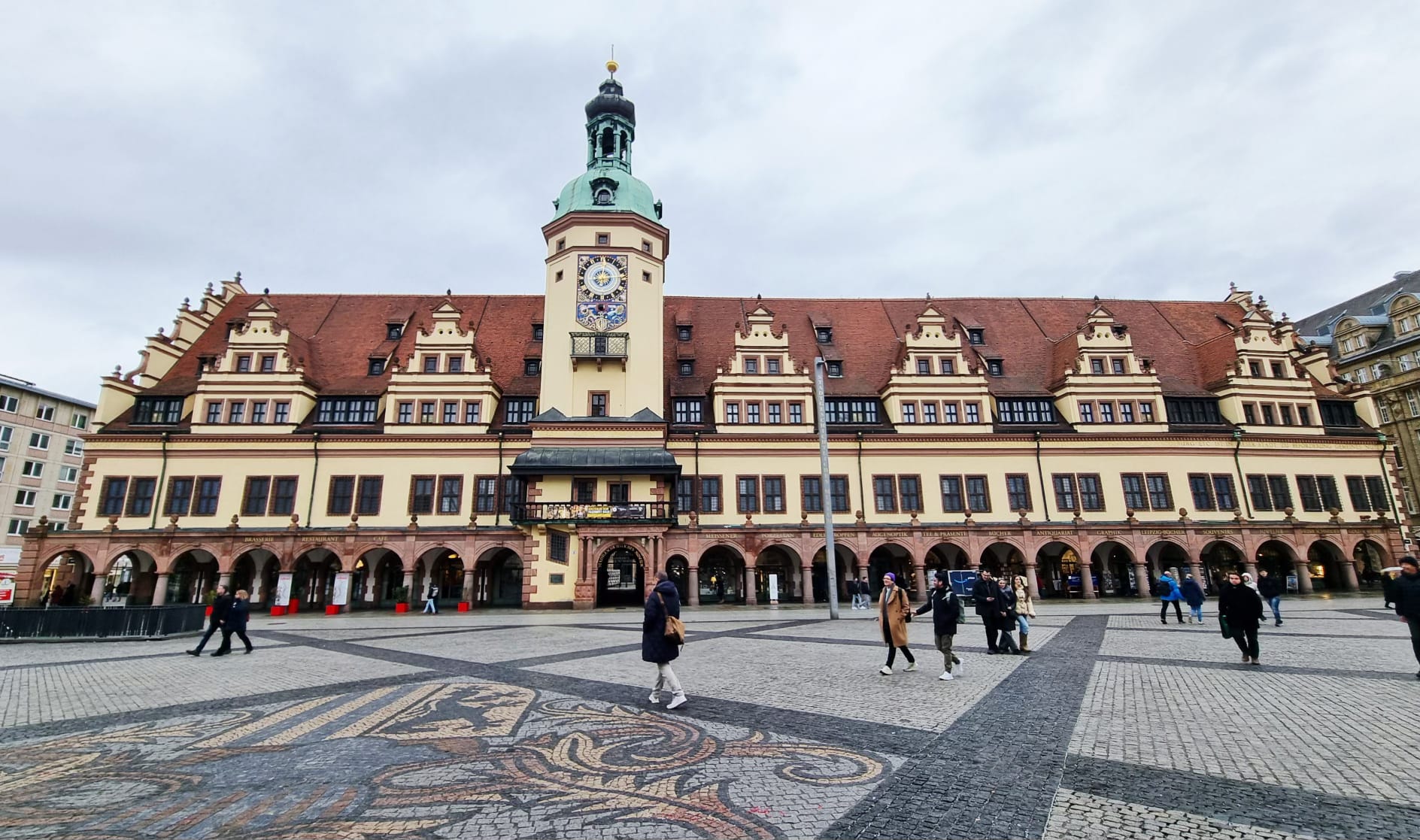
On the ground floor of the building are some shops, and we find one full of souvenirs. Darren buys a postcard for his missus, and I get a metal fridge magnet as a memento.
We sit outside a cafe and order four beers. Al's trying out his best German lingo, and to be fair, he's doing alright. The beers arrive quickly and we down two before moving on.
We've got a couple of hours to kill before we can check into the hotel, so we look for a sports bar to watch the early kick-offs and get something to eat. After a few pints and a pizza, we're just about ready to get a wriggle on.
Back at the hotel, we check in. I get my thermals on and wrap up warm. It's going to be a cold night at the Red Bull Arena.
Kick-off is at 5.30 so we've plenty of time to walk to the ground and soak up the atmosphere.
On the way, we find a busy little bar which has another Bundesliga game on the screen. We only stay for one, though; there's not enough room to swing a cat and barely room to stand up without getting in someone's way.
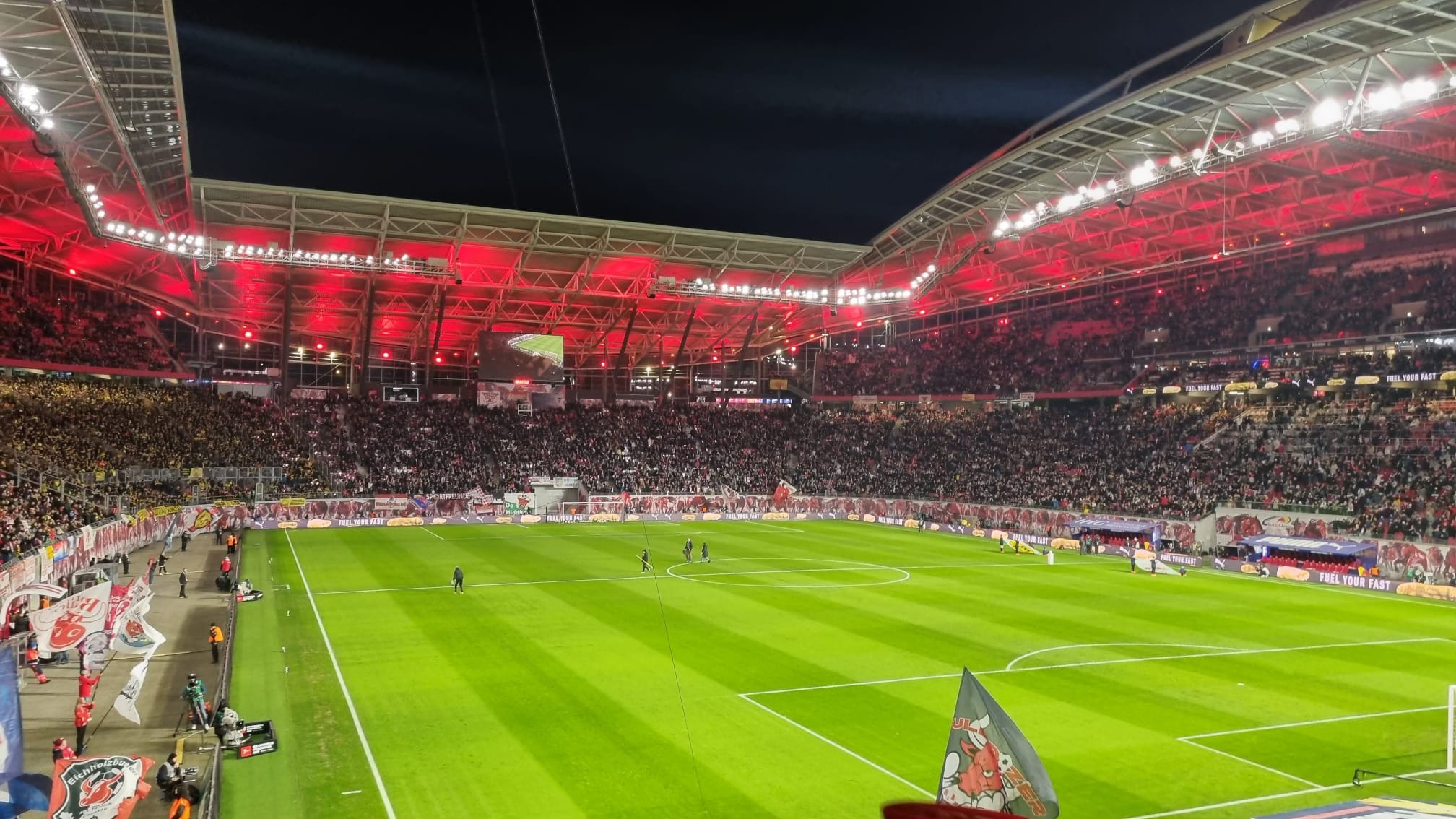
The red-neon-lit modern stadium soars high above us. Polished and gleaming, it rises high on the hill, a scarlet halo glowing against the dark night sky.
The modern 47,800-capacity stadium sits inside the vast remains of the Zentralstadion bowl, which was once the national stadium of East Germany, itself capable of hosting 100,000 spectators. The terraces of the former monolith, once a symbol of strength and power, are now grass-covered. This is a shrine, an ancient monument to a bygone era of socialist and communist megalomania.
Tonight, Leipzig have decided to play in blue. It’s a marketing stunt; Leipzig have released their fourth kit - a glow-in-the-dark blue shirt, and tonight is its official launch.
The terrace behind the goal in Sector B is packed, and I am whisked back to the 80s and 90s when I first started watching Southampton at The Dell in the old First Division. As a kid, I watched through the metal fence in the Archers Road End, eyes level with the pitch, looking up in awe at my heroes doing battle in front of me under the floodlights - while the casuals, rival fans, and the skinheads waged war on the terraces behind me.
We’re two blocks away from the RasenBallsport Leipzig (RBL) Ultras, and they’re in good voice, singing for the entire match and waving their flags irrespective of what is happening on the pitch.
By the time Christoph Baumgartner has put the home side 2-0 up in the 39th minute, we have got chatting to some of the home fans around us.
They tell us that RasenBallsport Leipzig (RBL) are not respected by the other Bundesliga clubs because they do not stick to the 50+1 rule of fan ownership that the other clubs follow. Leipzig, backed by money from Red Bull GmbH, acquired the playing rights of fifth-tier club SSV Markranstädt in 2009 and promptly moved into this brand-new stadium purpose-built for the 2006 World Cup in Germany.
RBL took just seven seasons to reach the Bundesliga from the fifth tier of German football, finishing second in their first year in the top division.
In the far corner of the ground to our left, BVB fans are quiet. They are not waving their flags and singing as they usually would at an away fixture. We are told that this is done by all away fans here, in protest against the commercialisation of football in Leipzig.
We make up an impromptu song about Jobe Bellingham, who is playing for Dortmund.“You’re not as good as your brother”, we sing, referring to Jobe’s older brother Jude Bellingham, who had also spent some time at Dortmund. The guys behind us join in, but the ultras aren’t impressed. Singing at football in Germany is choreographed and scripted.
At the front of the terrace on a raised platform, Ultra leaders direct the chanting and the jumping. This is not the place for individualism or witticism. Being in the home end in Germany is about showing your commitment to the common cause.
After half-time, Dortmund get themselves back in the game through a Rômulo own-goal. The Brazilian is unable to get out of the way of a deflected header and watches forlornly as the rebound trickles in off his head.
Another Dortmund goal deep into time added on makes it 2-2, and the yellow wall in the corner celebrates passionately.
Despite the late goal, this is still a decent result for RBL, and the ultras are pleased with the effort from the players who come over for their appraisal.
Our journey back to the hotel is quick and interrupted only by another visit to the sports bar and a nightcap in the hotel lounge. It’s late when we retire to our rooms.
Tomorrow we have a lunchtime kick-off at Lokomotiv Leipzig to get to. They play in the fourth tier of German football at the Bruno-Plache-Stadion. The forecast is rain.
Epilogue
The demon Mephisto awakens from his slumber as the four drunken travellers return to the hotel. From his cold and cramped alcove, he peers menacingly out from under his grubby, mucus-stained blanket and smiles a toothless grin.
But by the time the four tourists reach the lounge bar and order their drinks, Mephisto has transformed himself again. Now, he is a barman at the hotel, waistcoated and taking their orders.
“These drinks,” he says, “are on the house.”
“They will bring you worldly knowledge, magic, and pleasure. All I ask for in return is your eternal souls.”
One of the group mumbles a carefree response, and the other three laugh at the inside joke pointing in the region of Stef’s nob. These would be the cheapest drinks they would ever earn.
*
Later, Mephistopheles drags each of the four men one-by-one into the staff elevator and presses a single button with his bony, fleshless finger.
And, as the heat rises, the four passengers sleep on, obliviously.
This elevator is going down.
All the way down.
* The story of Faust is a classic German legend about a dissatisfied scholar who trades his soul to the Devil for worldly knowledge, magic, and pleasure. Based loosely on a real historical alchemist named Johann Georg Faust, the tale became a powerful symbol of human hubris and ambition through famous adaptations by Christopher Marlowe and Johann Wolfgang von Goethe.
** Doctor Faustus by Christopher Marlowe (c. 1592): A dark tragedy where Faustus uses his power for petty tricks and worldly fame, ultimately realising his immense mistake too late as devils drag him down to eternal damnation.